Birdella INSIGHTS
Kassovitz, Cannes,
and the
Copyright Question
That Won’t Go Away
22nd April, 2026
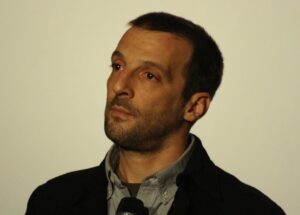
When Mathieu Kassovitz — director of La Haine, winner of three César awards, one of the most significant voices in European cinema — dismisses concerns about AI and copyright with “f**k copyright,” the instinct is to treat it as provocation for its own sake.
It isn’t. And engaging with it seriously tells us something important about where the debate around AI and intellectual property is actually heading.
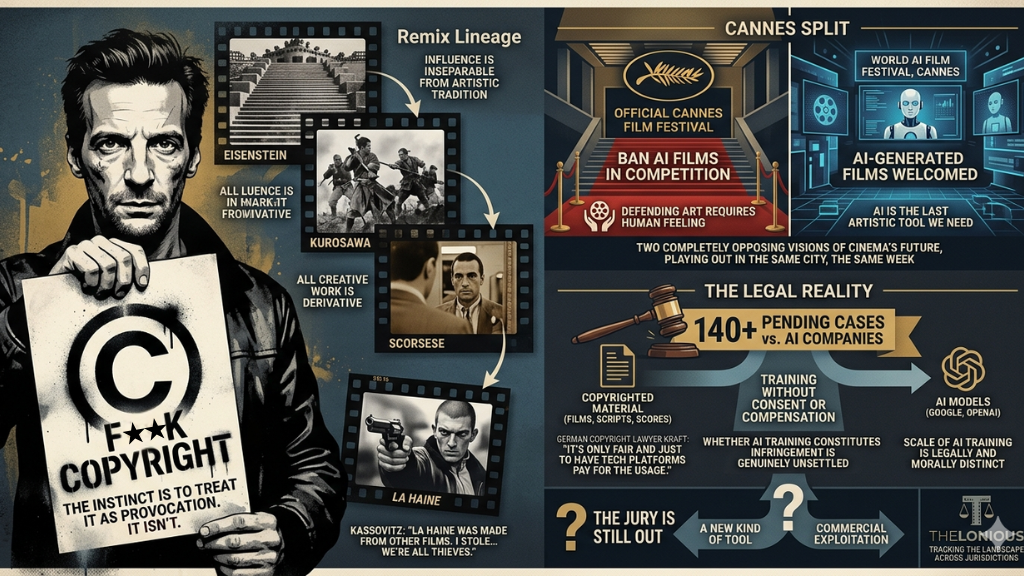
Kassovitz was speaking at the World AI Film Festival in Cannes — an event that ran in parallel to the main Cannes Film Festival, which this month announced a ban on AI-generated films in its official competition. The juxtaposition is almost too neat: two completely opposing visions of cinema’s future, playing out in the same city, in the same week.
The “All Art Is Remix” Argument — Applied to AI
Kassovitz’s copyright position isn’t original to AI. It’s a version of an argument that creative theorists, remix artists, and cultural historians have been making for decades: that all creative work is derivative, that influence and borrowing are inseparable from artistic tradition, and that the idea of wholly original authorship is largely a legal fiction.
His own framing: “La Haine was made from other films. I stole shots from Scorsese that he stole from Kurosawa that he stole from Eisenstein. Unless you created something from the ground up, we’re all thieves. So, as AI steals everything, it doesn’t steal anything.”
It’s intellectually coherent. And for anyone who has spent time thinking about the history of artistic influence, it resonates.
But it elides a distinction that matters enormously in a legal context: the difference between conscious, selective creative influence — a filmmaker choosing to reference a master — and the automated, mass ingestion of copyrighted material to train a model, without the knowledge or consent of the rights holders, and at a scale that no human creative process has ever operated.
What the Courts Are Actually Deciding
The philosophical argument and the legal one are running on separate tracks — and it’s the legal one that will determine how the creative industries are restructured over the next decade.
As Tim Kraft, a leading German copyright lawyer also speaking at the World AI Film Festival, noted: there are now almost 140 pending cases against AI companies over copyright — predominantly in the US, but increasingly in Europe. The question at the heart of most of them is whether training an AI model on copyrighted material constitutes infringement, and if so, what remedy is owed to rights holders.
The “all art is remix” argument has not, historically, been a successful legal defence. Courts have generally drawn a distinction between transformative human creative work — which attracts fair use or fair dealing protections — and straightforward reproduction or commercial exploitation of copyrighted material. Whether AI training falls into either category remains genuinely unsettled.
What is clear is that the scale of AI training is legally and morally distinct from human creative influence. Kassovitz spending years immersed in cinema, consciously channelling Scorsese in a single shot, is not the same as a model ingesting millions of films, scripts, and scores in days, without attribution or compensation, for commercial deployment.
Kraft’s framing is more precise: “It’s only fair and just to have tech platforms pay for the usage — they make bazillions. We need to urgently find a solution to have the likes of Google and OpenAI pay for their usage because they operate on our knowledge and copyrighted material.”
The Cannes Split — And What It Reveals
The fact that the World AI Film Festival and the main Cannes Film Festival coexisted this month — in opposition to each other — is the clearest possible illustration of where creative culture stands right now.
On one side: established gatekeepers of cultural value, defending the idea that art requires human feeling and that AI “imitates very well, but will never feel deep emotions” (festival president Iris Knobloch). On the other: practitioners — filmmakers, technologists, studios — already working with AI, already producing outputs they find artistically credible, and already cutting production costs dramatically.
Kassovitz represents a third position, perhaps the most interesting: a filmmaker who has made genuinely human, emotionally powerful work, and who nevertheless sees AI not as a threat to artistic soul but as a new kind of tool — “the last artistic tool we need.”
His admission that seeing a convincing AI performance “breaks my heart” is worth sitting with. He isn’t indifferent to what’s being lost. He just doesn’t think it should stop the technology.
What This Means for Legal and Creative Professionals
For law firms and in-house legal teams, the Kassovitz interview is less a cultural curiosity than an early indicator of the arguments clients will be making — and facing — in coming years.
The creative industries are moving fast. Hollywood studios are integrating AI, investing in AI companies, and hiring tech leaders to manage the transition. Val Kilmer appeared posthumously in a film trailer last week, his performance AI-generated with permission from his estate. The legal frameworks for consent, licensing, and compensation in this context are being built in real time — through litigation, negotiation, and legislation.
The 140+ pending cases are the opening round. The frameworks they produce will define the relationship between AI companies and rights holders for a generation.
(Tracking that landscape — across jurisdictions, across case types, across legislative developments — is exactly what our platform Thelonious is built for.)
Is Kassovitz Right or Wrong?
Kassovitz is right that creative culture has always involved borrowing, influence, and transformation. He is wrong — or at least legally premature — to treat that as a settled answer to the questions AI raises about copyright.
The more interesting question isn’t whether AI “steals” in the way he means. It’s whether the legal and commercial frameworks governing creative industries will adapt fast enough to reflect what AI actually does — and to protect the creators whose work makes it possible.
That question is being answered right now, in courts and legislatures across the world.
We’re watching.